
The Director of the UNIVEN’s Centre of Excellence in Mass Spectrometry in Southern Africa (CEMSSA), Prof Edwin Madala, recently led a strategic scientific visit to the Copperbelt University (CBU) in Zambia as part of efforts to advance regional integration and strengthen scientific collaboration across the SADC region. He was accompanied by Prof Luke Chimuka (Wits) and Prof Ashwell Ndhlala (UL) following an invitation from the Head of Chemistry at CBU. The visit builds on CEMSSA’s broader regional engagement programme, which previously included a similar outreach visit to the University of Zimbabwe in March 2025.
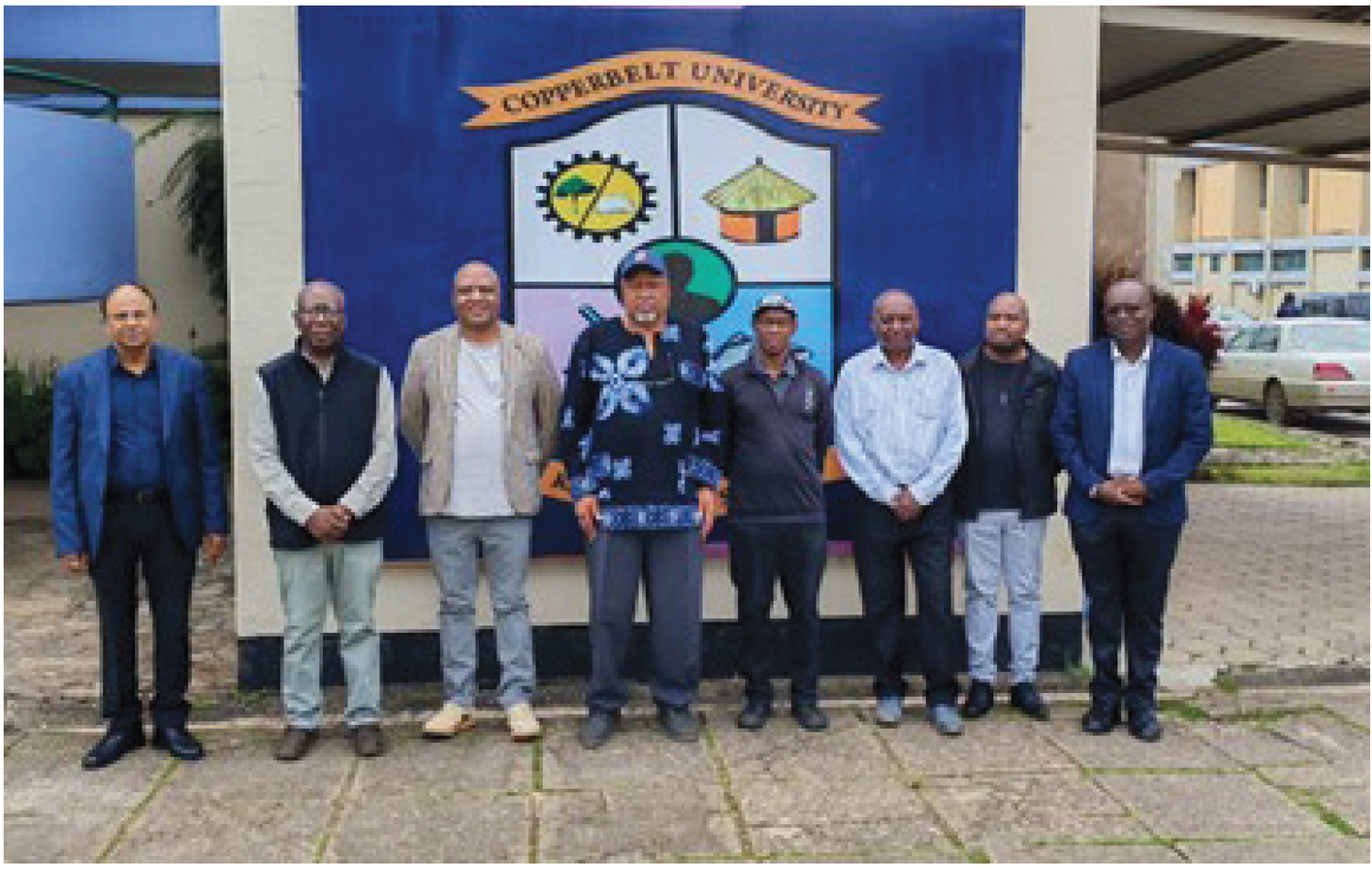
The visiting professors standing with the management of CBU. From left to right: Prof. Indra Singh (Head of Chemistry), Prof. Paul Chisale (Deputy Vice-Chancellor for Academic Affairs), Prof. Edwin Madala (CEMSSA), Prof. Imasiku Anayawa Nyambe (Vice-Chancellor), Prof. Luke Chimuka (Chemistry), Prof. Kenneth Maseka (Dean of Science), Prof. Ashwell Ndhlala (Plant Sciences, and Prof. Bernard Hang’ombe (Deputy Vice-Chancellor for Research and Innovation)
During the visit, the delegation held high-level engagements with CBU leadership, including the Vice-Chancellor, Deputy Vice-Chancellors and Director of Research. Discussions focused on strengthening collaboration between researchers at CBU and CEMSSA, expanding existing partnerships, and enhancing research capacity in mass spectrometry and analytical sciences.
The collaboration between the institutions has already yielded tangible outcomes. Earlier in 2025, two Chemistry students from CBU visited the University of the Witwatersrand and later conducted research on mass spectrometry at the University of Venda. During their stay at UNI-VEN, more than 50 plant extracts were analysed using advanced mass spectrometry systems. Faced with challenges in interpreting complex MS data, the students received support from the UNIVEN team and were introduced to SIRIUS software, significantly improving their data analysis capabilities.
A major focus of the visit was the urgent need for investment in high-speed computing infra-structure to support the growing demands of MS data analysis. CBU management expressed a commitment to investing in entry-level analytical instrumentation to enable local scientists to conduct preliminary analyses in-house while benefiting from shared MS data generated through collaboration with UNIVEN.
The engagements also extended to the government level, with a Director from Zambia’s Min-istry of Science participating virtually in discussions. The Ministry highlighted challenges with several non-functional HPLC systems procured in Zambia, due to limited technical expertise, and requested support from the visiting delegation to assist in restoring the equipment and to advise on future scientific infrastructure procurement.
The Ministry further commended the establishment and operational model of CEMSSA, partic-ularly its strong emphasis on capacity building and regional collaboration. Through CEMSSA, Prof Madala committed to continued support for CBU scholars with mass spectrometry-related research needs. The collaboration has already resulted in three manuscripts currently under development from shared datasets, with at least two publications anticipated within the year.
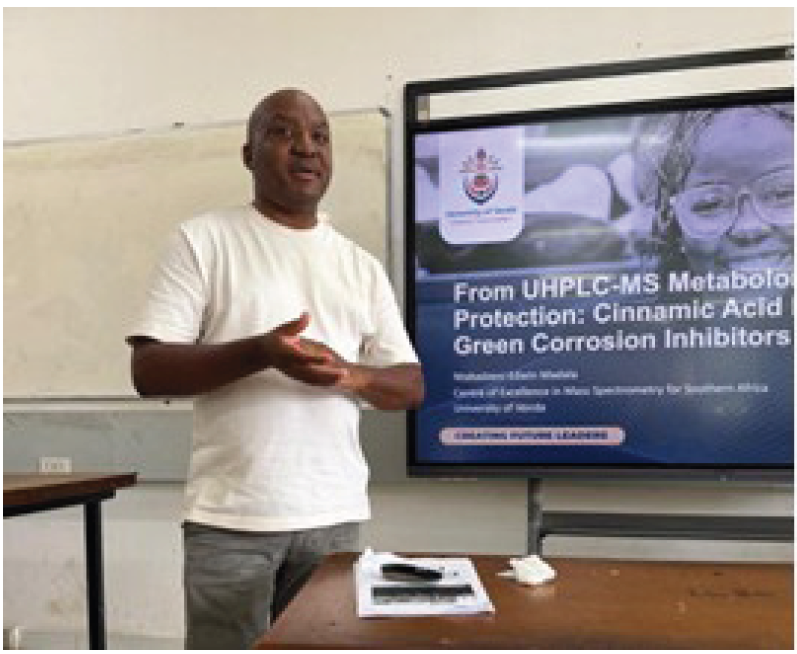
Prof. Edwin Madala delivering a public lecture at CBU on mass spectrometry research conducted at UNIVEN
As part of the academic programme, the three visiting professors delivered lectures in their respective areas of expertise. Prof Madala presented a lecture titled “From UHPLC-MS Metab-olomics to Metal Protection: Cinnamic Acid Derivatives as Green Corrosion Inhibitors.” The pre-sentation resonated strongly with the university community, particularly given CBU’s location in Zambia’s mining-intensive Copperbelt Province. The lecture highlighted the potential use of plant-derived compounds as environmentally friendly corrosion inhibitors and provided in-sight into the chemical complexity of plant systems and the influence of environmental factors on metabolomic diversity.
The visit also included capacity-building sessions on manuscript and proposal writing, which were especially well received by junior academic staff. The professors shared practical guid-ance on developing high-quality, publishable scholarly work and strengthening research com-petitiveness.
On the final day, Prof Madala delivered a lecture on the application of artificial intelligence in scientific data analysis. The session explored how tools such as ChatGPT and Google Colab can be used alongside Python programming to analyse scientific data and generate simplified infographic models for MS data reporting. The lecture also addressed the ethical use of AI in academia, emphasising its value as a tool for learning, innovation and productivity while cau-tioning against misuse in generating unsupported academic content.
The visit marked another important milestone in advancing scientific collaboration, research capacity and regional integration within Southern Africa. Discussions toward finalising a Mem-orandum of Understanding (MoU) between the institutions are underway, with expectations that the partnership will continue to grow and deliver impactful scientific outcomes across the region.
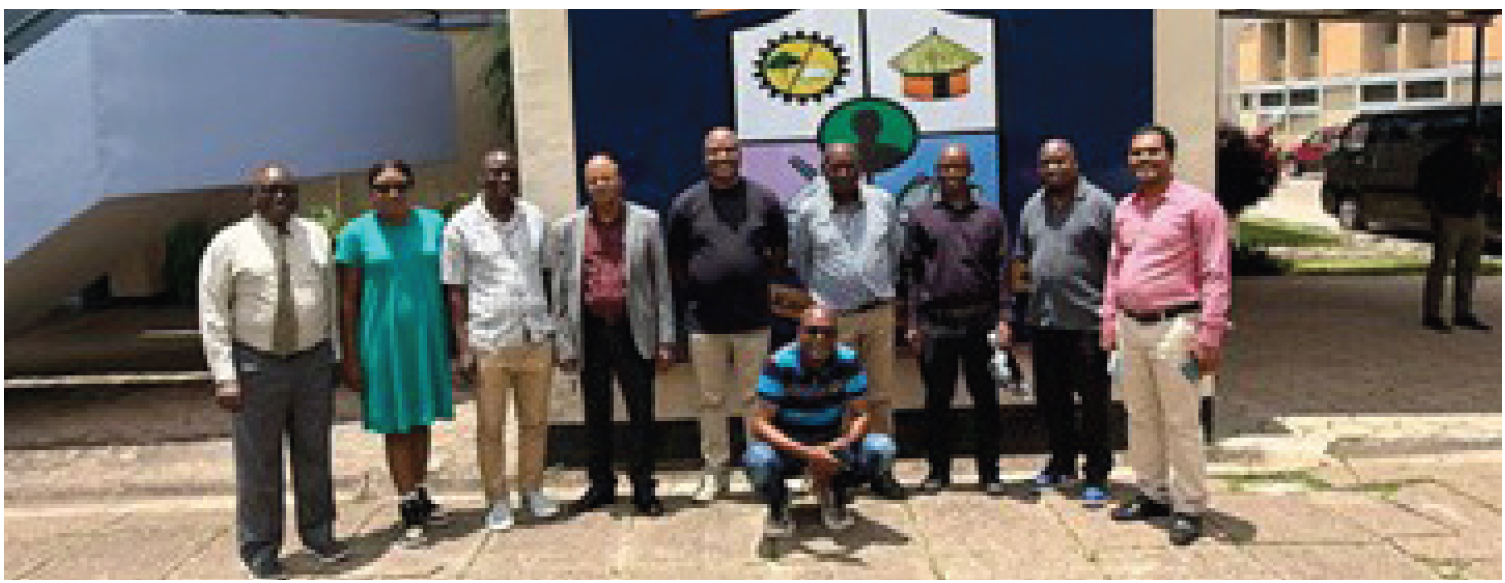
Prof. Madala, together with two other visiting professors, poses for a photo with CBU Chemistry staff after the writing workshop.
Issued by:
Department Marketing, Branding and Communication
University of Venda
Tel: 082 868 2218 / 082 868 1811


