
The Faculty of Science, Engineering, and Agriculture (FSEA) at the University of Venda (UNIVEN) hosted a public lecture delivered by Prof. Hossein Kazemian from the Department of Geography, Earth and Environmental Sciences at the University of Northern British Columbia (UNBC), Canada. The lecture, titled “Zeolites, Clays and Zeolitized Fly Ash for Environmental Chemistry: Low-Cost Pathways to Cleaner Water and Healthier Soils,” aimed to share knowledge on affordable and sustainable materials for environmental remediation. It focused on how zeolites, natural clays, and zeolitized fly ash can be used as cost-effective solutions to improve water quality, restore soil health, and address pollution challenges in communities. The lecture took place on 14 November 2025 at the UNIVEN Research Conference Centre and was attended by postgraduate students, academic staff, and researchers from various departments, with support from representatives of the FSEA Office of the Executive Dean.
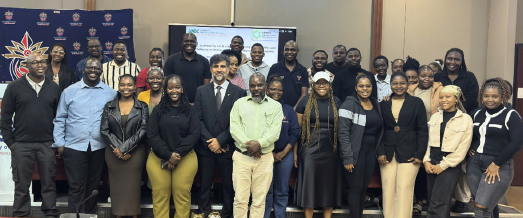
Attendees of the public lecture pose for a group photo with guest speaker Prof Hossein Kazemian (middle)
The Programme Director, Dr Hloniphani Moyo, began by inviting students to share their expectations for the lecture. This activity encouraged the audience to express what they hoped to learn and helped open the discussion. By collecting these expectations, Dr Moyo provided the guest speaker with a clearer understanding of the audience’s interests, which helped him focus the presentation on topics most relevant to the students and staff.
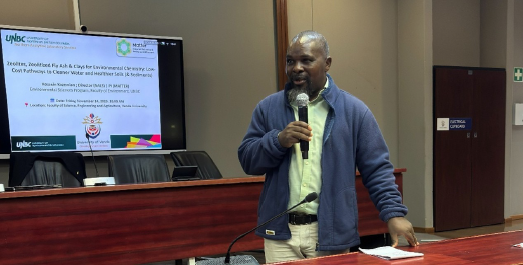
Prof Michael Chimonyo
The welcome remarks were delivered by Prof Michael Chimonyo on behalf of the FSEA Deputy Dean of Research and Postgraduate Studies, Prof Lutendo Murulana. He welcomed all attendees and extended a warm welcome to the guest speaker. Prof Chimonyo thanked Prof Kazemian for visiting UNIVEN and highlighted the University’s unique location within the Vhembe Biosphere, noting that UNIVEN is committed to enhancing its international visibility through research and collaboration with international institutions. He emphasised that UNIVEN strives to produce graduates who are locally and globally competitive. In addition, Prof Chimonyo highlighted the three key research niche areas of the University of Venda: One Health, African Heritage, and In-digenous Knowledge Systems. He emphasised that University activities, including public lectures, should support these focus areas and encouraged the guest speaker to engage freely with the audience and to partner with UNIVEN’s researchers to embark on research that safeguards the health of people, animals, and the environment.
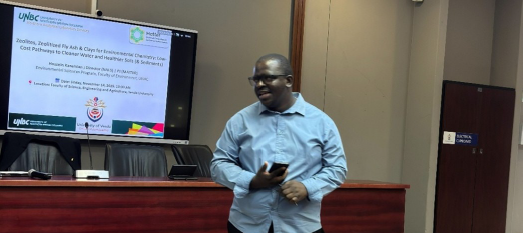
Dr Rabelani Mudzielwana
Dr Rabelani Mudzielwana introduced the guest speaker by outlining Prof Kazemian’s academ-ic background and research contributions. He informed the audience that Prof Kazemian is an Associate Professor in the Environmental Science Programme at UNBC and the Director of Northern Analytical Lab Services, which forms part of Northern BC’s Environment and Climate Solutions Hub. Dr Mudzielwana explained that Prof Kazemian’s research focuses on porous ma-terials, including natural and synthetic zeolites, MOFs/ZIFs, and MOF-polymer hybrids, which are used in environmental monitoring and remediation. He highlighted Prof Kazemian’s leadership in multi-partner projects that link materials chemistry with practical solutions to improve air and water quality. He also noted his commitment to ensuring that scientific knowledge benefits soci-ety and to supporting early-career researchers and students.
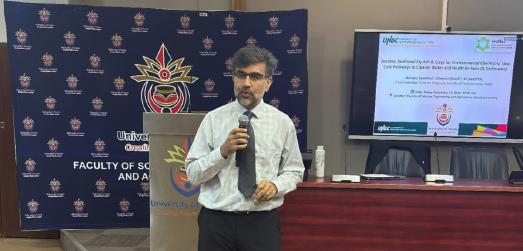
Prof Hossein Kazemian presenting his public lecture on the use of natural and synthetic zeolites, coal fly ash, and functionalized clays as cost-effective solutions for water and soil remediation
In his public lecture, Profs Kazemian discussed the use of porous aluminosilicates, including natural zeolites, engineered zeolites produced from coal fly ash, and functionalised clays, as low-cost and scalable solutions to environmental challenges at the water-soil interface. He explained that his research focuses on translating these materials from laboratory studies to real-world applications, thereby supporting sustainable resource management. He began with a historical overview, noting that the first zeolite, Stilbite, was described by the Swedish scientist Axel Fredrik Cronstedt in 1756. Among the more than 50 natural zeolites, only a few, such as Clinoptilolite, Mordenite, Phillipsite, Analcime, and Chabazite, are found in large deposits. He described natural zeolites as “La Roca Magica,” meaning “The Magic Rock,” and referred to major developments in synthetic zeolites by Milton and Breck in the 1950s. He added that by March 2025, 260 synthetic zeolites had been reported and explained the development of metal-organic frameworks in the 1990s.
Prof Kazemian described the multifunctional properties of porous materials, including ion ex-change, adsorption, catalysis, and hydration. He explained how coal fly ash can be converted into high-capacity ion-exchange materials and adsorbents through hydrothermal zeolitization, enabling the removal of nutrients such as ammonium, metals, and organic contaminants from water. He outlined the methods used to test these materials, including batch screening, column breakthrough modelling, and regeneration protocols, which help assess their lifespan, cost, and performance under different water conditions. In soil systems, he explained that zeolite-amend-ed compost can serve as a slow-release nutrient reservoir, enhancing nutrient retention, reduc-ing leaching, supporting agricultural productivity, and protecting downstream water quality. He also described the use of modified clays for the selective adsorption and immobilisation of pol-lutants in soils and sludges. While he briefly mentioned MOFs as advanced materials for specific applications, he emphasised the importance of using locally available and affordable materials that support circular economy practices.
Prof Kazemian provided further explanations on natural and synthetic zeolites, with particular focus on the conversion of coal fly ash into zeolites. He presented graphs illustrating the pro-duction and use of coal combustion products and discussed environmental disasters associated with coal fly ash. He also described different zeolitization methods, including microwave-assisted, ultrasound-assisted, and synthesis from pure chemicals. He compared direct hydrothermal and indirect fusion processes, highlighting the effectiveness of ultrasound-assisted zeolitization. The lecture concluded with case studies demonstrating the successful applications of zeolitized coal fly ash in removing environmental contaminants and enhancing soil quality using zeolite-modi-fied compost.
In his closing remarks, Mr Mavhungu Sydney Muthige thanked the staff and students for at-tending and expressed sincere appreciation to Prof Kazemian for sharing his research with the UNIVEN community. He commended the practical nature of the lecture, noting that it addressed real-world environmental problems rather than being purely academic. He expressed hope that Prof Kazemian would return to the University in the future, as the lecture was valuable to both staff and students.
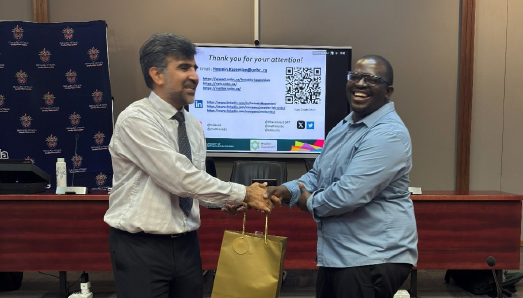
Dr Rabelani Mudzielwana presenting a token of appreciation to Prof Hossein Kazemian
Issued by:
Department of Marketing, Branding and Communication University of Venda
Tel: 082 868 2218 / 082 868 1811


