
An advisory forum to structure the ecosystem engagement to improve Entrepreneurship, Inclusive Innovation, and Commercialisation was launched recently to strengthen the ecosys-tem with Industry, civil society, municipalities, and government. The launch of the Advisory Forum marks a significant step in institutionalising an ecosystem of engaged scholarship and partnership that supports Vision 2040 and the University’s transformation agenda. It reflects the University’s commitment to ensuring that our work remains responsive to societal needs, enhances sustainable socio-economic development, and positions the University as a catalyst for change within the region and beyond.

Prof Vhonani Netshandama, Director of Community Engagement, Entrepreneurship, Inclusive Innovation, and Commercialisation, while setting the scene for the launch
Prof Vhonani Netshandama, the Director of Community Engagement, Entrepreneurship, Inclu-sive Innovation, and Commercialisation (CEEIIC), emphasised the importance of collaboration, co-creation, and mutual benefits between the university, industry, government, and civil soci-ety to address societal challenges and foster socioeconomic development.
She highlighted the need for the University of Venda (UNIVEN) to transition from the traditional “ivory tower” model to an engaged university model. An involved university fosters mutual ben-efits through cooperative activities, shared understanding, and co-creation with external com-munities. The forum aims to produce employable graduates who can create value in society and contribute to socioeconomic development. It seeks to establish a regional network of entrepreneurial universities that promote industry, culture, and co-creation. The forum will focus on curriculum development, income generation, and the practical application of research findings to benefit society. She acknowledged the historical challenges universities have faced, including working in silos and failing to address the implications of research find-ings. Prof Netshandama urged stakeholders to commit to the forum and actively participate in its initiatives, emphasising the need for a deliberate, collaborative approach to ensure its suc-cess and long-term sustainability.
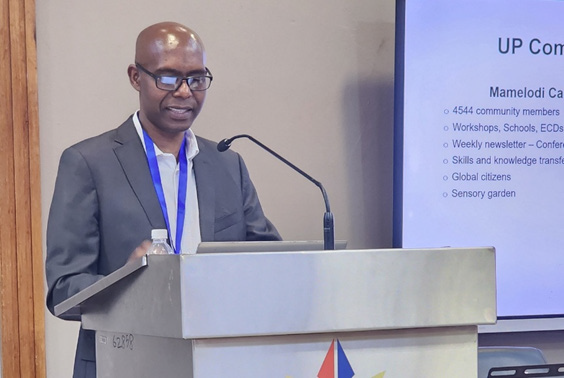
Dr Eugene Machimana, Head of Curricular Community Engagement at the University of Pretoria
Dr Eugene Machimana, Head of Curricular Community Engagement at the University of Preto-ria, delivered an insightful keynote address. Dr Machimana emphasised the University of Pre-toria’s commitment to being an agent of social change through its Curricular Community Engagement (CCE) framework. He highlighted the importance of engaging stakeholders for mutual benefit and of integrating teaching, learning, and research with community engage-ment to achieve sustainable, impactful outcomes. He further outlined the seven-step pathway to impact, which includes embedding the CCE philosophy, building capacity, conducting stake-holder analysis, fostering collaboration, piloting initiatives, monitoring and evaluating out-comes, and ensuring sustainability.
Dr Machimana commended Prof Netshandama and the CEEIIC team for successfully securing the participation of key stakeholders, including university executives, students, traditional lead-ers, community partners, and representatives from both the private and public sectors. It was an honour to share the platform with Prof Fulufhelo Netswera, Deputy Vice-Chancellor: Research and Postgraduate Studies, and Prof Joseph Francis, Director of the Institutes for Rural Development, among other distinguished dignitaries. Their addresses and visible sup-port for CEEIIC were both insightful and inspiring.
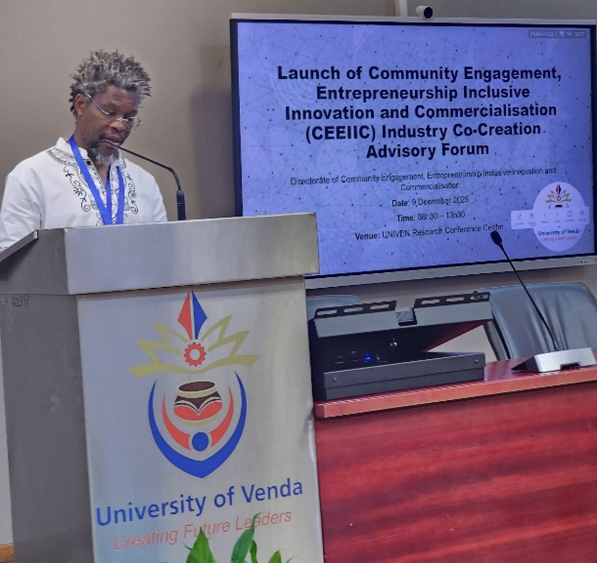
Prof Fulufhelo Netswera, Deputy Vice-Chancellor Research and Postgraduate Studies, launching the CEEIIC Co-Creation Advisory Forum
In his launching speech, Prof Fulufhelo Netswera, highlighted that historically, Universities operated as Ivory Towers, i.e., Theology Colleges in Europe, whose ideals were elitist, exclusive, and detached from society. Over the years, universities have transformed, pioneering and find-ing solutions to societal challenges in both the corporate and government sectors. Hence, in the 1990s, a new model of a university was developed, commonly referred to as the triple helix model. He mentioned that the triple helix model argues that universities should collaborate with the government and the industry. Prof Netswera added that around the 2000s, the Quad Helix Model was developed, suggesting that the university should not function solely in part-nership with government and industry, but also with civil society. “My personal vision for UNIVEN is to see a university embedded in society, executing society’s informed research agenda. The CEEIIC Co-Creation Advisory Forum responds particularly to that agenda, champi-oning solutions that are driven by research and community engagement through prob-lem-based learning and problem-based teaching.” Said Prof Netswera.
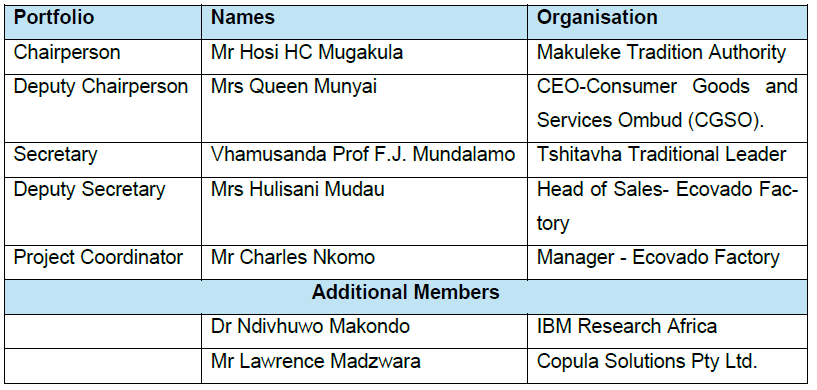
List of the CEEIIC Co-Creation Advisory Executive Committee:
UNIIco creation advisory has been made possible in part by the Erasmus + CBHE funding dedicated to transforming entrepreneurship education in the Southern African Development Community (SADC) region. Led by Higher Education Reform Experts Africa (HERE-Africa) and coordinated by the Technological Higher Education Network South Africa (THENSA), the proj-ect aims to build entrepreneurial universities that foster co creation between universities, in-dustries, and civil society.
The launch of CEEIIC Co-Creation Advisory Forum has been made possible by the Erasmus + CBHE funding dedicated to transforming entrepreneurship education in the Southern Afri-can Development Community (SADC) region, led by Higher Education Reform Experts Africa (HERE-Africa) and coordinated by the Technological Higher Education Network South Africa (THENSA), the project aims to build entrepreneurial universities that foster co-creation be-tween universities, industries, and civil society
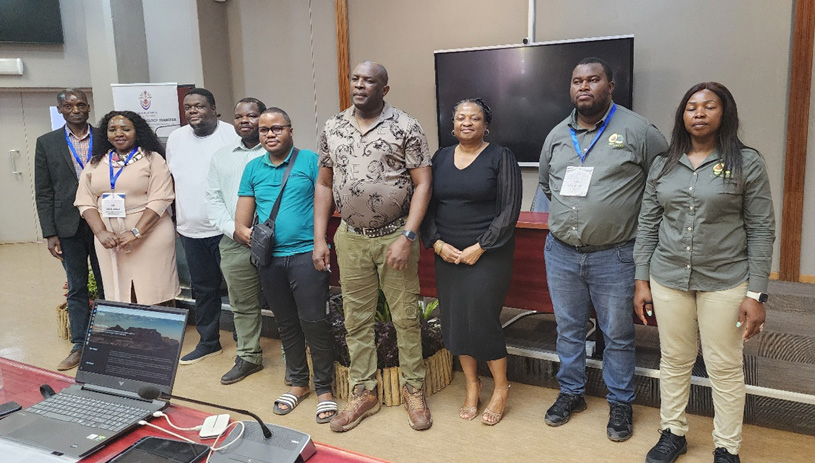
Executive Members of the CEEIIC Co-Creation Advisory Forum
Department of Marketing, Branding and Communication University of Venda
Tel: 082 868 2218 / 082 868 1811


